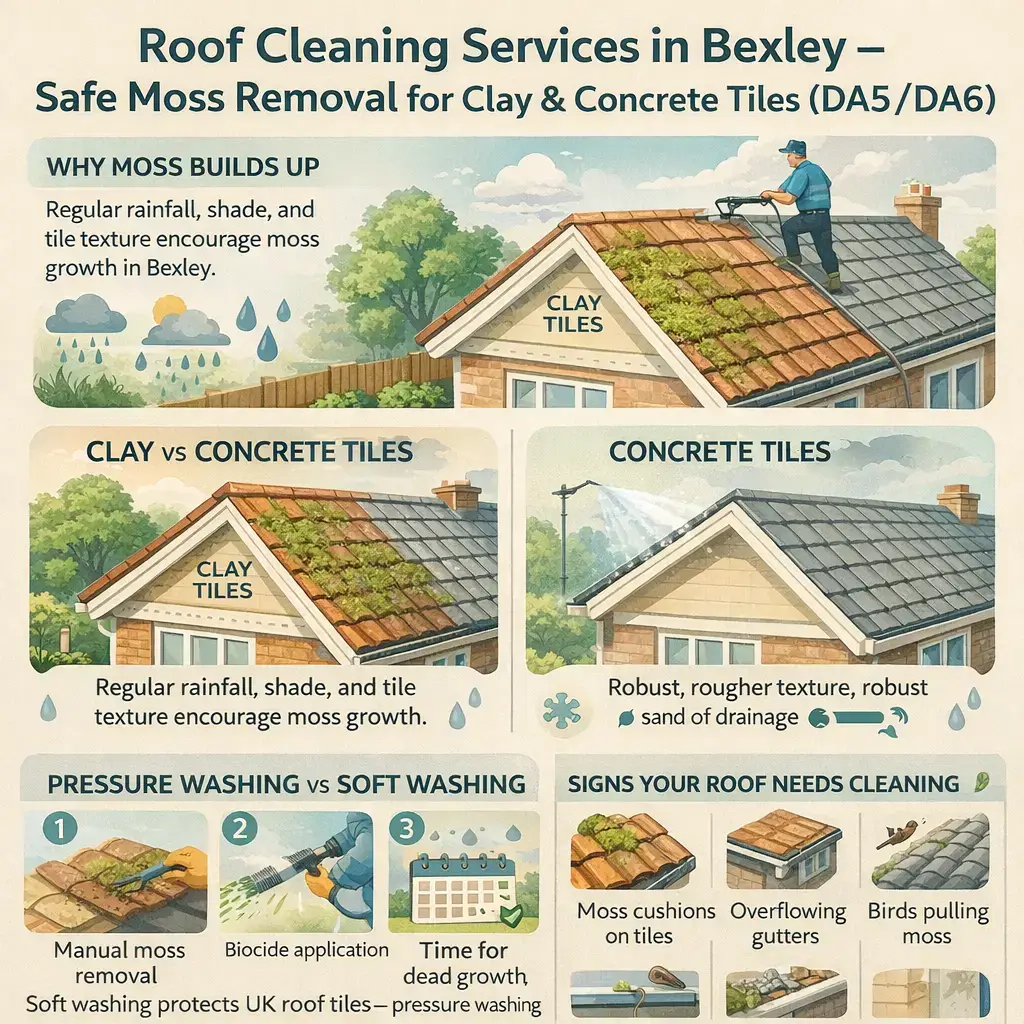
If you live in Bexley, you’ve probably noticed how quickly a roof can turn green—especially on the shadier sides of the house. In most of DA5 and DA6, the “problem” isn’t cosmetic staining like you see in some overseas guides; it’s moss building up on clay and concrete tiles, holding moisture, and quietly stressing the roofline over time.
A professional roof clean isn’t about blasting everything with pressure. Done properly, it’s a careful balance of safe access, gentle removal, and targeted treatment—so the roof looks better and stays healthier for longer.
Why moss builds up on Bexley roofs (local conditions + tile types)
Bexley sits in a sweet spot for moss: plenty of greenery, regular rainfall, and lots of roofs that don’t get full-day sun. Moss loves cool, damp surfaces, and it takes hold fastest where moisture lingers—north-facing slopes, areas under trees, and tile overlaps where water can sit.
Clay tiles vs concrete tiles: why it matters
In Bexley, you’ll commonly see:
- Clay tiles (often older properties): durable, but can be brittle if walked on incorrectly.
- Concrete tiles (very common across suburban housing): robust, but the surface can be affected if treated aggressively.
Moss doesn’t just sit on top—it can root into the rough texture, especially on concrete tiles. As it thickens, it can:
- Hold moisture against the tile surface (slower drying)
- Encourage frost-related wear in colder spells
- Block drainage paths at tile edges
- Contribute to debris build-up in gutters and valleys
The goal is to remove moss without damaging the tiles, underlay, pointing, flashing, or guttering.
Our roof cleaning in Bexley is delivered as part of our comprehensive roofing services
Soft washing vs pressure washing: what’s safe for UK tiles
Pressure washing can look satisfying on social media, but it’s often the wrong tool for UK roofs—particularly on tiled roofs in residential areas like Bexley.
Why high pressure can cause real problems
A strong jet can:
- Dislodge or crack tiles (especially older clay)
- Force water up under tile laps and into the roof space
- Strip surface coatings and accelerate weathering
- Disturb ridge/hip pointing or mortar fillets
- Send a lot of mess into gutters and downpipes (and onto neighbours’ paths, parked cars, and gardens)
What “soft washing” actually means
Soft washing is a low-pressure approach that combines:
- Manual moss removal (carefully, with roof-safe tools)
- A controlled application of biocide treatment
- Time—because the treatment continues working after the visit
For many Bexley homes, a soft wash approach is the most sensible option because it’s gentler on tiles and targets moss regrowth at the root level rather than just shifting visible growth around.
“Clean & Treat” explained: biocide and longer-lasting results
A proper roof clean is best thought of as clean + treat (not just “make it look nice today”).
Step 1: Manual removal (the tidy bit)
Most reputable roof cleaning jobs begin with carefully removing heavy moss. This reduces the bulk quickly and prevents large clumps dropping into gutters later.
Step 2: Biocide treatment (the long-term bit)
A professional-grade biocide is applied to the roof surface to kill off:
- Moss spores
- Algae growth
- Lichen traces
You won’t always see the final result instantly. In many cases, the roof continues to improve over the following weeks and months as weathering helps rinse away dead growth naturally. That slower improvement is often a sign the job was done in a measured, roof-friendly way—rather than a rushed “before/after” blast.
How long does it last?
It depends on shade, nearby trees, and roof pitch, but the point of treatment is to keep the roof cleaner for longer and slow regrowth—especially in areas where moss returns every year.
Signs your roof needs cleaning (before leaks start)
Not every roof needs cleaning all the time. But there are clear warning signs that moss and debris are starting to impact performance—not just appearance:
- Visible moss “cushions” along tile rows or around chimneys
- Gutters overflowing in normal rain (not just storms)
- Green staining that returns quickly after a rainy spell
- Birds nesting or pulling at moss (a surprisingly common clue)
- Debris in valleys (especially where roof slopes meet)
- Damp patches in the loft near the eaves after wind-driven rain
- Water marks on fascia/soffit areas from repeated overflow
Persistent moss growth can also contribute to blocked gutters and repeated water overflow, which may affect fascia boards and soffits over time. Keeping the roof and drainage system clear helps protect these important parts of the roofline.
Catching it early is usually cheaper and simpler than dealing with blocked guttering, interior damp, or slipped tiles later.
Cost factors in Bexley (size, access, pitch, tile material)
Roof cleaning costs in Bexley vary because roofs vary. Two homes in the same street can price differently depending on what’s happening up at roof level.
The main drivers are:
Roof size and shape
A straightforward roof with easy access is quicker than a complex roof with multiple slopes, dormers, or extensions.
Access and safety setup
Safe access matters. Properties with limited rear access, conservatories, or awkward side paths may require additional setup to do the job properly and safely.
Pitch (steepness) and tile type
Steeper roofs and older tile types often need more time and careful handling.
Level of moss build-up
Light growth is one thing. Thick moss that’s been building for years is another—it takes longer to remove and typically creates more debris management.
Gutter condition and debris management
A good roof cleaning service will think about where moss goes next. If you remove moss but leave gutters packed, you’ve shifted the problem rather than solved it.
A sensible approach is to request a local inspection and get a quote based on the specific roof, rather than relying on a one-size online price.
If moss build-up or drainage issues are starting to affect your roof in Bexley, Gutters Gurus can assess the condition safely and recommend a practical, roof-friendly solution.
FAQ
1) Is pressure washing bad for roof tiles?
It can be. High pressure may crack or dislodge tiles, strip protective surfaces, and force water under the tiles—especially on older clay tiles or roofs with vulnerable pointing. A low-pressure, treatment-led method is often safer for tiled UK roofs.
2) How much does roof cleaning cost in Bexley?
Costs vary depending on roof size, pitch, access, tile type, and how much moss there is. The most accurate way is a site visit or photo-based assessment so the quote reflects your specific roof.
3) How often should I remove moss from my roof in the UK?
It depends on shade and nearby trees. Homes under tree cover or with north-facing slopes may need attention more often than open, sunny roofs. Many homeowners choose periodic “clean & treat” maintenance to slow regrowth.
4) What’s included in roof moss removal (clean & treat)?
Typically: careful manual removal of heavy moss, controlled application of a biocide treatment, and sensible debris management. Many services also recommend checking gutters afterwards because loosened moss can collect there.
5) Will roof cleaning help prevent damp and leaks?
It can reduce risk. Moss holds moisture and can contribute to drainage problems (like blocked gutters/valleys). While cleaning won’t “repair” existing defects, it can help the roof shed water more effectively and highlight any issues that need attention.
6) Is soft washing safe for clay and concrete tiles?
When done properly, yes. Soft washing uses low pressure and relies on treatment rather than force, which is generally more compatible with common UK tile roofs.
7) How long does biocide treatment take to show results?
Some improvement can be immediate after moss removal, but the roof often continues to brighten over weeks/months as dead growth weathers away. This gradual change is normal for treatment-led cleaning.
8) Do I need to be home for a roof cleaning appointment?
Not always. Many homeowners arrange access and confirm the scope in advance, then receive before/after photos or a short report. It depends on access requirements and your preference.